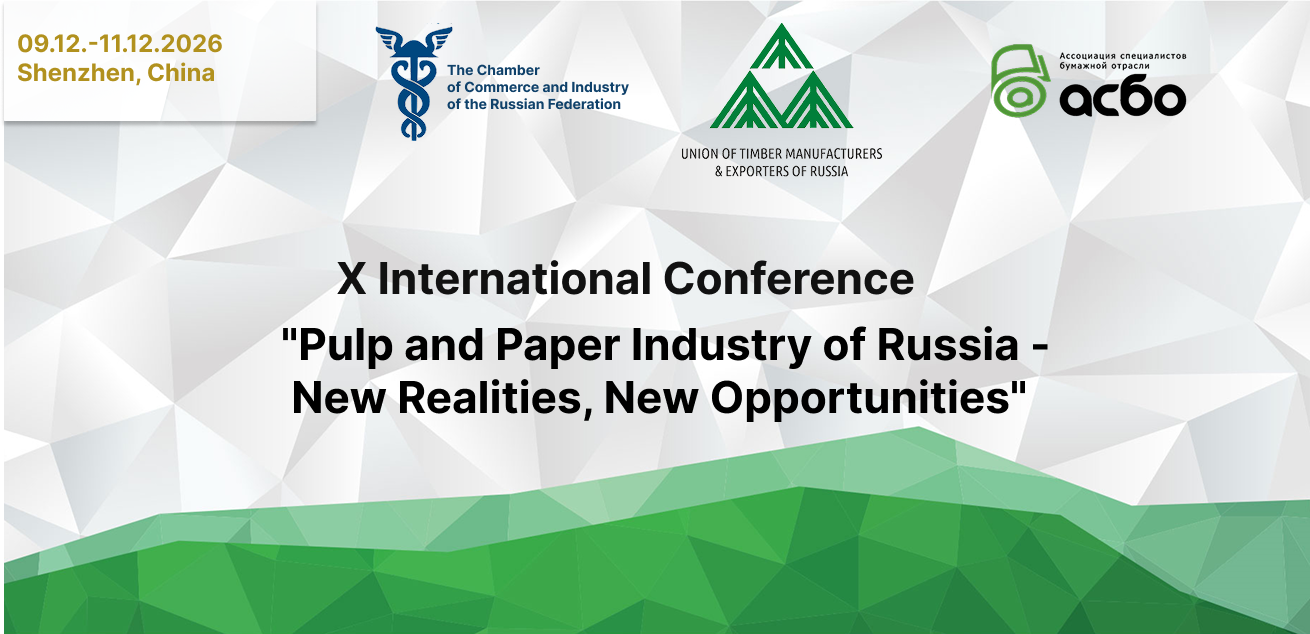
Istanbul Conference 2025

Visit the conference site at: conference.ppi-russia.org
IX International Conference "Russian Pulp and Paper Industry - NEW REALITIES, NEW OPPORTUNITIES" took place on the dates from 11 till 12 December 2025 in Istanbul, Turke
At the meeting of the Organizing Committee it was decided to hold the next international conference in Shangri La Bosphorus Hotel, Istanbul (Turkey), scheduled for December 11-12, 2025.
The main aim of the Conference is to ensure a constructive professional dialog between business structures, potential investors and representatives of governmental authorities, whose decisions determine the functioning of the pulp and paper industry in Russia.
How did the conference go?
The IX International Conference: A Dialogue on the Future of the Pulp and Paper Industry — from the Global Economy to Management Decisions

The IX International Pulp and Paper Conference served as a platform for substantive professional dialogue between business, the expert community, and representatives of government bodies. Over two days, participants consistently discussed key industry development issues: economic conditions and global markets, technological solutions and localization, export opportunities, as well as the interaction between the PPI and the state, and the management practices of enterprises under new conditions.
The conference demonstrated that the industry is going through a complex period of transformation while maintaining resilience, engineering potential, and significant interest in Russian products on foreign markets.
Conference Opening: A Frank Conversation on Challenges and Points of Support
Opening the conference, the President of the Union of Russian Timber Industrialists and Timber Exporters, Miron Tatsyun, emphasized that interest in the event remains high, including from international participants. Companies and experts from India, Turkey, China, Germany, Austria, Finland, and other countries took part.
In his speech, he outlined the key challenges the industry has faced in recent years: geopolitical changes, trade restrictions, currency fluctuations, and rising investment costs. These factors have had a noticeable impact on the economic performance of the pulp and paper industry and led to a decline in production in a number of areas.
At the same time, Miron Tatsyun noted that the situation in the industry is not uniform: alongside volume declines in basic segments, growth persists in certain niches—printing paper, specialized packaging types, sack paper. A number of enterprises continue to launch new production facilities and master the output of more technologically advanced products.
His opening remarks paid special attention to technological sovereignty. He highlighted the importance of national projects in chemistry and materials, the development of domestic machinery for the timber sector, as well as the need for systemic export support and adjustments to environmental regulation. In his view, it is precisely the combination of efforts by business and the state that can create conditions for the industry's sustainable development.
Day One: Economics, Technology, and Export
-
Economic Resilience and Global Markets: The first day's discussion set the analytical framework for the entire conference, moderated by Miron Tatsyun, and united leaders of major enterprises, international analysts, and industry consultants. Key points included:
-
Irina Galakhova, Chairperson of the Board of Directors of JSC Arkhangelsk PPM, noted Russian enterprises' resilience but stressed that further development is impossible without deep modernization of equipment, energy efficiency, logistics, and a balanced environmental policy.
-
Metin Mete, CEO of Hayat Marketing LLC, presented an overview of the sanitary and hygiene products market, highlighting the stable and growing tissue segment.
-
Aleksandr Boychenko, Chairman of the Board of Directors of PPM (likely Perm Pulp and Paper Mill), cited rising cost of capital, logistical constraints, and regulatory burden as factors limiting corporate investment activity.
-
Tarek Helou, COO of TTO LLC (UAE), provided an international perspective, analyzing the impact of tariffs, volatile Chinese demand, and price disparities. He forecast a potential price upturn in H2 2026.
-
Alexey Beschastnov, Senior Manager at StepChange Consulting, commented on Western companies' adaptation strategies, including a pivot to Asian, Latin American, and Middle Eastern markets.
-
-
Technology, Engineering, and Localization: This session, moderated by Evgeny Glezman, Chairman of the Board of SFT Group, focused on practical opportunities in equipment, services, and new products. Key takeaways were:
-
Presentations from Chinese engineering companies (e.g., Xu Chen from China Haisum Engineering) on EPC project cooperation with Russian clients.
-
Emphasis on developing specialized types of pulp (dissolving, viscose, microcrystalline) by Dmitry Khrapach, First Deputy General Director of JSC Arkhangelsk PPM.
-
Discussions on modernization, digitalization, and personnel development (Mikhail Poilov, SFT Group).
-
A realistic view on localization from Alexey Vdovin, CEO of A-Technology, who argued for prioritizing repair/service localization, component production, and preserving engineering expertise over full equipment localization.
-
-
Export: Interest Persists, but Barriers Remain: Moderated by Tarek Helou and Irina Gavrilenko, the export discussion confirmed sustained foreign interest in Russian products, hindered by logistical complexities and insufficient state support depth. Highlights included:
-
Overviews of the Turkish market (Isa Doganli, ex-CEO of Cukurova Paper) and reorientation to Asia/Middle East/Africa (Sergey Pondar, CEO of JSC Volga).
-
Alexey Chernyaev, Senior Vice President of Ilim Group, noted the phenomenon of Chinese mills producing paper marketed as "Russian," indicating the high reputation of Russian brands.
-
Insights on export support mechanisms (Timur Safin*, Russian Export Center) and growing Middle Eastern interest (Yulia Bronina*, AI PPI Trading).
-

Day Two: The State, Regulation, and Management Decisions
-
Industry and Government Dialogue: Dedicated to systemic issues of PPI-state interaction, moderated by Nikolay Krotov (RF CCI) and Anatoly Safronov (Union of Timber Industrialists). Discussions covered:
-
Regulatory approaches to closed-loop economics and environmental fees (Vladimir Rudenko, Ministry of Natural Resources).
-
Turkish EPR and recycled fiber practices (Mahmut Ciger, Turkish Recyclers Association).
-
Advanced forestry technologies (Alexander Stepchenko, research institute) and educational aspects (Alexander Dobrovolsky, university).
-
The dialogue revealed business expectations for more predictable, economically sound rules from the state, while authorities seek industry's active participation in policy formation.
-
How Enterprises Operate Under New Conditions: The conference concluded with a CEO roundtable moderated by Sergey Pondar. Leaders from major companies (Natalia Stupnikova, Dmitry Kolchin, Konstantin Malyshev, Maxim Pisarev, and Alexey Chernyaev) discussed adaptation, investment priorities, risk management, and long-term strategies.
Overall Conference Summary
The two days demonstrated that the industry retains resilience, strong engineering and managerial competencies, and remains in demand on external markets. However, its future development directly depends on the quality of technological solutions, logistics, the institutional environment, and business-state interaction.
The conference became not only a platform for exchanging views but also a basis for formulating practical proposals that will shape the development of the pulp and paper industry in the coming years.
See you in 2026!